Showing posts with label Silent Legions. Show all posts

Tuesday, 4 August 2015

RPG a Day so far

Last year, I participated in Dave Chapman's RPG a Day, and it prompted me to write and think about my gaming habits. Well, it's back, and I've been making videos for each day of the month so far. Here they are for those that haven't seen them.


I turned out not to have a good answer for the first question about games I was anticipating.


On the second day, I was a guest on the main RPG a Day video, talking once again about Silent Legions. It really is very good.


Day 3 was about things I've purchased in the last year, including recent ENnie winner A Red and Pleasant Land. It is also good.


In my next video, I talked about a game that surprised me; there was a cameo appearance by a classic.


And today, on Day 5, I talk about recent purchases including Tunnels & Trolls and Many Gates of the Gann.

Saturday, 25 July 2015

And now, a word from our sponsors

Just a short post today after Friday's novel! It's the Christmas in July sale over at DriveThru, and lots of things are 25% or more off. I thought I'd take a moment to go over all the reviews I've posted on this blog as well as last year's RPG a Day posts and see if any of the things I recommended are on sale. And what do you know, there are a few.

Maelstrom Domesday


A spinoff or reimagining of British classic Maelstrom (itself currently on sale for less than £3!), this is a game that's right up my alley and possibly no one else's, a scrub-level horror/mystery game set in England in the late 11th century with tons of period detail and a strong chance of being a disfigured peasant. I wrote a full read-through and a character creation post.

I do keep meaning to run this game, but when? Anyway, you can get it for super cheaps -- less than a fiver for the PDF -- on DTRPG right now, since there's an extra sale on.

After the Bomb

It's about cartoon mutant animals fighting in the wreckage of a nuclear-devastated America, and it started as a supplement for the Teenage Mutant Ninja Turtles RPG. Now it has its own system -- and OK, Palladium character creation is complicated and time-consuming, but it's dead easy to strip away the cruft. And you get a hell of a lot for just a few dollars with these After the Bomb PDFs. Road Hogs is my personal favourite -- and it's like £2.50! -- but they're all cool. It's the only post-apocalyptic hot rod samurai funny animal rockabilly western you're ever going to need.

Sadly, the original TMNT game is out of print, but my experience is that it's not hard to find on eBay, and there's a new After the Bomb RPG that all these books are compatible with.

The Flying Serpent


Not a game at all, just a weird historical document that would make a great prop for anyone running a supernatural mystery game set in England. And less than a pound.

Tunnels & Trolls


My very first RPG, this game has a fancy new edition, but you can actually buy the first edition from the 70s in PDF for less than two dollars American!

Cyberpunk


Your pal and mine Chris wrote a guest post about this classic after picking it up for a song at the SELWG bring and buy. I don't think the first edition is still available, but you can definitely get the second and third in PDF for about seven quid each. 

Everything Sine Nomine has done ever


The only thing more tiresome than my love for Silent Legions (two-part review here and here) is my fondness for Stars Without Number and its spinoff, Other Dust. Come to that, I just read Spears of the Dawn and enjoyed it as well. So I'm just gonna go ahead and endorse pretty much everything Kevin Crawford does. Get you some. 

So anyway, that's what I've reviewed or talked about on the blog that's currently on sale at DTRPG. Get 'em before the end of July for, you know, big savings. Three floors of values! You know the kind of thing. 

Friday, 1 May 2015

Silent Legions: the long-awaited Part Two!


In a previous post, I began my review of Silent Legions, the Lovecraftian-horror sandbox game from Kevin Crawford of Sine Nomine Publishing. I am a big fan of this type of game and its approach to worldbuilding, so I decided to put it into practice.

Pantheon and cults

Before starting to develop my setting, I created a pantheon, an alien race and some cults. I rolled for the gods and discovered that there were four of them, divided into two pantheons. One of the pantheons came up "monotheistic," so obviously that god, who I rolled as a god of fire -- the Sleeping Flame -- is the only god in its pantheon (I suppose that's not really a pantheon, then, but you know what I mean). The other pantheon has three gods, but they don't fully exist yet: I rolled "forerunners" for them, which means that they are waiting to be born into our reality. They are the Sultan of Cold, the King of Thirst and the Devourer of Pain.

So we have one god -- obviously, your passive, dormant type -- that already exists and three younger gods striving to be born. I'm guessing the Flame wants to make sure the others don't burst into our reality and displace it.

My alien race don't have a name yet, but the dice tell me that they've only been here for one to two hundred years and that they're capable of disguising themselves as humans. During their time on earth, they've created a concealed global network of underground structures to house themselves, and obviously one of these is located in the area where I'm going to set my game. They came to earth from another part of our solar system, and they use humans to incubate their larvae. They influenced astronomy -- I'm assuming to conceal the existence of their home -- until a group of humans banded together to stop them. I'll have to find somewhere discovered in the last few centuries to have them come from; Pluto is probably too predictable.

They fear the outer gods -- I decided to have this mean that they fear the new, yet-to-be-born gods. Perhaps they fled from their home to seek refuge from them?

They live within the human community, and they have the power of mind control, which they use to suborn the local government; they produce or have access to some kind of addictive substance they use to manipulate people. They place the highest value on reproduction -- I wonder if maybe they are dying out back home. In their normal physical form (when not impersonating humans) they are like half-intangible clouds with stalked eyes projecting from them. Their behaviour is ant-like; they have a queen and they obey her unquestioningly. They speak in airy, breathy voices, eat by liquefying and absorbing their food and seem to be motionless until they suddenly move with inconceivable speed.

When they die, they erupt into a swarm of immature larvae which will seek to burrow themselves into a human host. They won't mature, but they can do some damage.

By Luigi Castellani. 

I rolled up one cult, the Circle of the Iron Demiurge. They were founded in ancient history by an artist who received bizarre visions of something huge. They took control of a community in ancient history, recruiting their numbers from among artists; they infiltrated an existing faith and repurposed some of its temples, but they were opposed by a rival faith.

Today, they have embraced their uncontrollable artistic visions to the point that many of them are incapable of functioning in normal society. Each member has a hidden tattoo which they use to identify themselves; the cult is bounded together by a twisted form of familial love. The leader is a mad high priest, but he has possibly untrustworthy second-in-command. The cult wants revenge against someone -- maybe the descendants of the religion that fought them in antiquity? They are masters of diabolical sorcery, which is their chief weapon.

Here are the three major and three minor characters I created for the cult:


  • Seductive femme fatale
  • Merciless crime boss
  • Monstrous entity that resembles a human -- maybe one of the alien species has switched sides to work for the unborn gods rather than the Flame? 
  • Foolish street thug with grandiose plans
  • Sweet old lady carrying on a hideous family tradition
  • Ambitious young academic seeking cult secrets
The second cult I didn't bother rolling up; the alien race description made it clear that the other cult in the mix was going to be the mind-controlled slaves of the aliens. I assume they work in tiers with actual shape-shifted aliens at the top and the addicted thralls at the bottom. 

Basically all of this was generated randomly, I want to point out, and it all fits together into quite a nice little antagonist group. Certainly much more detail than I would probably have created in an hour of just thinking about it. And more importantly, not solely the kind of thing I would think of (and therefore the kind of thing my players would be able to predict). 

Locations


I decided to set my campaign right here in Cambridgeshire. The book recommends picking three urban locations, three rural locations and three remote locations, some of which are to be "red herrings," ie locations with no occult tag. I only did eight instead of nine. My locations were: 
  • Cambridge (city)
  • Cambridge (university)
  • Ely
  • Little Stukeley (red herring)
  • Westley Waterless
  • Ramsey Forty Foot
  • Ouse Washes
  • Gallows Hill
For each of these locations, you generate two tags, each of which contains an enemy, a friend, a scheme, a secret and a place. You pick these from a list of suggestions for each one. 

Cambridge City: Foul Faith. A local religion has been corrupted. Enemy: popular demagogue. Friend: concerned relative. Scheme: consecrate a place with an evil rite. Secret: the religion supports social services for the needy, despite its evil nature. Place: secret fane in important building. 

Crushing Despair. The people of Cambridge have lost hope in things ever getting better. Enemy: political machine boss. Friend: Successful expat returning home. Scheme: discredit source of hope. Secret: Constant plans for renewal always disappoint. Place: street with half the houses empty. 

This is an example of a location and its tags; I'm not going to type them all out because there's nine of them, so here's the summary. 

Ely: Horrific Wealth, Creeping Plague. Ely's privileged residents have some corrupt secret behind their wealth -- but can even that save them from the contagion that's about to break out? Are they, in fact, linked? 

Cambridge University: Drug Epidemic, Damnable Saviour. A new designer drug is doing the rounds among students -- it's even being made by students. But the drug has side effects that one of the cults is keen to harness or put a stop to. A wealthy patron tries to battle the problem, but has secrets of her own. 

Little Stukeley: Clannish Silence, Old Grudges. Stukeleians (is that a word?) don't trust outsiders, and anyone who tries to tell people about what's going on gets put down by the brutal clan leaders. Two factions within the village fight, with an unscrupulous gun runner selling to both sides. 

Westley Waterless: Senseless Violence, Buried Power. A local archaeological site has a hidden being beneath it -- a zealous young archaeologist struggles with the local landowner for access. Does the site have something to do with the bizarre rash of violent crimes in the area? 

Ramsey Forty Foot: Depraved Clergy, Entrenched Poverty. In this poor village, a violent strain of old-timey witch-hunting religion has arisen. 

Ouse Washes: Poisoned Ground, Inhuman Masters. Chemical spills are contaminating the area -- they come from a hidden lab run by a rogue scientist. Is it tied in to the aliens' attempt to create a device to communicate with their offworld allies? 

Gallows Hill: Hateful Tradition, Predator Entity. Bigoted locals enact a cruel local rite believed to appease an evil spirit. There is an evil spirit -- but it isn't appeased. Bodies of the locals' victims are believed to be consumed by the monster, but in fact it eats something less substantial -- a part of the soul, or the sanity. 

It's spookier if you know it's called the Devil's Dyke. 
So there you have it -- that's probably a year's worth of sessions, although they're not all developed, and it took me about two hours while watching television. And as you can see, they're not necessarily Mythos-y; the plot concepts are sufficiently broad that they can fit anywhere. I like enough of these plots that I may well use them, and several of them are not what I would have thought of without using the generator. I particularly love the aliens, the cult, all that stuff. 

There are lots of tools for me to quickly create the next steps as well -- I'd start with this level plus local knowledge, improvisation and charm, and then when the players wanted to actually go somewhere in the sandbox I'd quickly whip up the relevant spells, critters, artefacts and so on. Probably the only thing I'd do more of in advance is the cult's sorcery; given that it's important to them I would want to make sure I had some strongly-established visuals and names to act as clues. 

By Luigi Castellani.
I have discovered my first flaw in the game, though! Well, it's not a flaw per se, more like a caveat; it's just that the tags will require a little adjustment to make them work in a wainscot UK setting (rather than a World-of-Darkness-type setting), and of course they'll need even more fiddling to make fit a specific city. The second point is true anywhere; Cambridge is filthy rich; that's its problem, and the idea of a street with empty houses, rather than people paying £200K to live in a shoebox and be beaten with rods, is risible. But I'm the one that chose it; I was shooting for a more WoD-y concept anyway. And that would be true anywhere; a tag that makes sense one way in New York needs a little work to make sense in Muscatine. 

The national point is a little more an artefact of the game itself; it's set in America, and some of the tags reflect that, assuming that guns are everywhere and there's lots of murders and so on. I struggled with fitting some of the tags to really remote locations, also; if I were to do this again I think I would make it a big city and not bother with the remote country stuff; I'd make "village" the lowest level of resolution, rather than somewhere really out in the middle of nowhere. Mind you, I think that some of the crime assumptions would work OK in London or even somewhere like Birmingham or Glasgow or somewhere; you can believe that film-noir stuff in a way that's hard to believe about Cambridge. So maybe my home is just weird. 

I hope this has given you an example of how the sandbox generation works and why I think this game is so great; I'm not rolling to see how many of this or what type of columns are in the lobby or what kind of guns the thugs have. I'm rolling for the narrative elements, and then I'm fitting it all together like some mad game of Iron Chef. You can see how useful this is for modern-horror setting creation. Honestly, it should be in every World of Darkness ST's tool kit; that's probably the closest thing on the market to a modern horror sandbox, and it lacks anything like this, at least as far as I know. 


Seriously, you guys; if you run any kind of modern horror game, get this one. Link's at the top of the post. 


Wednesday, 22 April 2015

Silent Legions, Part One:

Late last year, I backed the Kickstarter for Silent Legions, the new horror roleplaying game from Sine Nomine's Kevin Crawford. I'm on record as being a big fan of previous Sine Nomine games like Stars Without Number and Other Dust, so I was in for this without a lot of reflection. Last week I picked up my hardback copy (I've had the PDF for ages, but haven't really got around to digging into it), so here is my review.

By Miguel Santos.
(Incidentally, as one of the stretch goals of the Kickstarter, Crawford put the game's art out for free use, so I'm going to illustrate with a lot of images from that.)

In my next post, I'm going to put some of the tools in the game to use and generate a sample setting, but I've got a busy week ahead so heaven knows when that will actually happen. Anyway, let's get down to our look at the game itself.

System Overview

Silent Legions is a relatively rules-light game, although it's still a "fat" game. I suppose what I mean is that it's rules-light, resource-heavy. The core of the system is a familiar model based on older versions of D&D. You have the traditional six stats, classes and levels, descending armour class, all that kind of thing. The saving throws are different, and there's a skill system, but if you've played any form of D&D -- and I expect that's most people -- it should be pretty easy to pick up.

The four classes are the Investigator, the Scholar, the Socialite and the Tough. These pretty much do what they say on the tin -- they get skills in relevant areas, they have different attack progressions, hit dice and saving throws, etc. The really distinctive feature of the classes is Expertise. Each character has a pool of Expertise points which represent the particular training or specialty of their class. Players can spend these expertise points to do things like reroll class skills or to activate class special abilities. For instance, at first level the Scholar can spend a point of Expertise to automatically succeed on a Knowledge skill roll, while the Tough can spend an Expertise point to automatically self-stabilise when knocked to 0 HP. That kind of thing.

In addition to classes, players also have Backgrounds, which give them some more skills and act as sort of specialisations. A Tough with the Soldier background and a Tough with the Police Officer background will be quite different, for instance -- and Police Officer might also be a good one for an Investigator.

Skills in Silent Legions, as in its sister games, are pretty forgiving. You start with a skill at 0, which allows you to roll 2d6 and add the relevant attribute with no penalty. The typical difficulty is somewhere around 8, so a character with just a +1 between attribute and skill will still succeed most of the time -- and even then, the rules suggest that many uses of skills should just be auto-successes if the character has the relevant skill at all.

Combat, by contrast, is super fucking deadly. In addition to its regular damage, each type of weapon has what's called a Slaughtering die. So, for instance, a shotgun does 3d4 damage and has a Slaughtering die of d10. When you roll the weapon's attack, you also roll the Slaughtering die. If it comes up 6 or better, the weapon does triple damage. So 50% of the time, a successful shotgun blast will kill a typical human stone goddamn dead with damage to spare. Which, you know, fair enough. Don't get shot with a shotgun if you want to stay alive. But it's not like there's a huge number of armour options available out there in the modern world. Primitive armour doesn't work against guns, ballistic armour doesn't work against not-guns, and everything is stupidly conspicuous.

By Luigi Castellani
So combat uses a d20 and has wildly dangerous damage results, while skill use runs on 2d6 and is pretty generous. The result is that using skills is relatively predictable, whereas every single time you go into a fight you're taking your life in your hands. That's true in the other Sine Nomine games, but it's even more true here and it's clearly intentional. I like it. It means that -- fighting monsters aside -- combat is going to be either fisticuffs or murder; the last thing you want is a fair fight with someone who's trying to kill you.

Heck, even if you succeed at murdering people, there's Madness to worry about. Madness in Silent Legions is a type of cumulative damage; it builds up, rather than wearing you down like it does in Call of Cthulhu, and you can buy down your total by buying Deliria, which are sort of behavioural coping mechanisms. You can accumulate Madness from different types of source: there's Bloodshed, Horror and the Occult. It's not a bad system, and it would be easy to bolt onto other games where you wanted a relatively light sanity system. It also -- and I think this is a good thing -- makes it very clear that the Madness you get from the things your characters are exposed to in the game and actual mental illness are totally different; you can have a character who is mentally ill but has a Madness of 0.

Magic

In Silent Legions, there are two types of magic: Spells, which are time-consuming rituals you do beforehand, which then produce a suspended effect, and Disciplines, which are more sort of psychic-powery and have an immediate effect. The distinction reminds me of the difference between Thaumaturgy and Evocation in the Dresden Files game (and, for all I know, books), although the parallel isn't exact. There are rules for learning both types of magic, and anyone can do them (although you need some Occult to do Spells effectively). You buy Disciplines like Skills, and then advance through ranks in them, much like Psychics do in Stars Without Number. In either case, you can either spend Expertise to cast the Spell or use the Discipline or rack up some Madness by doing so -- since Expertise is a pretty limited currency at lower levels, this seems like it would happen quickly.

Now, the Spells for which there are rules in Silent Legions are merely the spells of the "Gray Path," i.e. the kind-of-evil path that any old person can study. Most spells are not so gray -- they're flat-out evil and if you were to learn them, you'd no longer be a PC. These spells don't have a list; instead, they have a big old random-generation process. And it's in this section of the book that we really start to get into what I love about Sine Nomine games: the GM tools.

A ... World of Darkness? 

I feel like I never do a very good job of expressing what I love about the way Crawford presents game master tools. I always just say something like "it's all done with random tables" and then I think people put this down to a quirk of mine -- and in a way, it is. I definitely love random tables for reasons I can't fully explain.

But the setting generation tools in Stars Without Number, Other Dust and now Silent Legions aren't just "random tables." They're thematic hook-generating tools. They're like ... Traveller world creation if it only focused on the things that make for good adventures.

Key to the system is creating locations with tags. When you start assigning locations on your map, you generate tags for them. A tag is a short descriptor, like "Alien Bloodline" or "Senseless Violence." There are both occult tags and mundane tags, so you can create locations that don't necessarily have anything Mythos-y about them or you can mix the two to set a horror against a realistic background. Each tag comes with suggested hostile NPCs, allies, objectives, dark secrets and so on. A tag is a little scenario-generating engine, and each location has two of them.
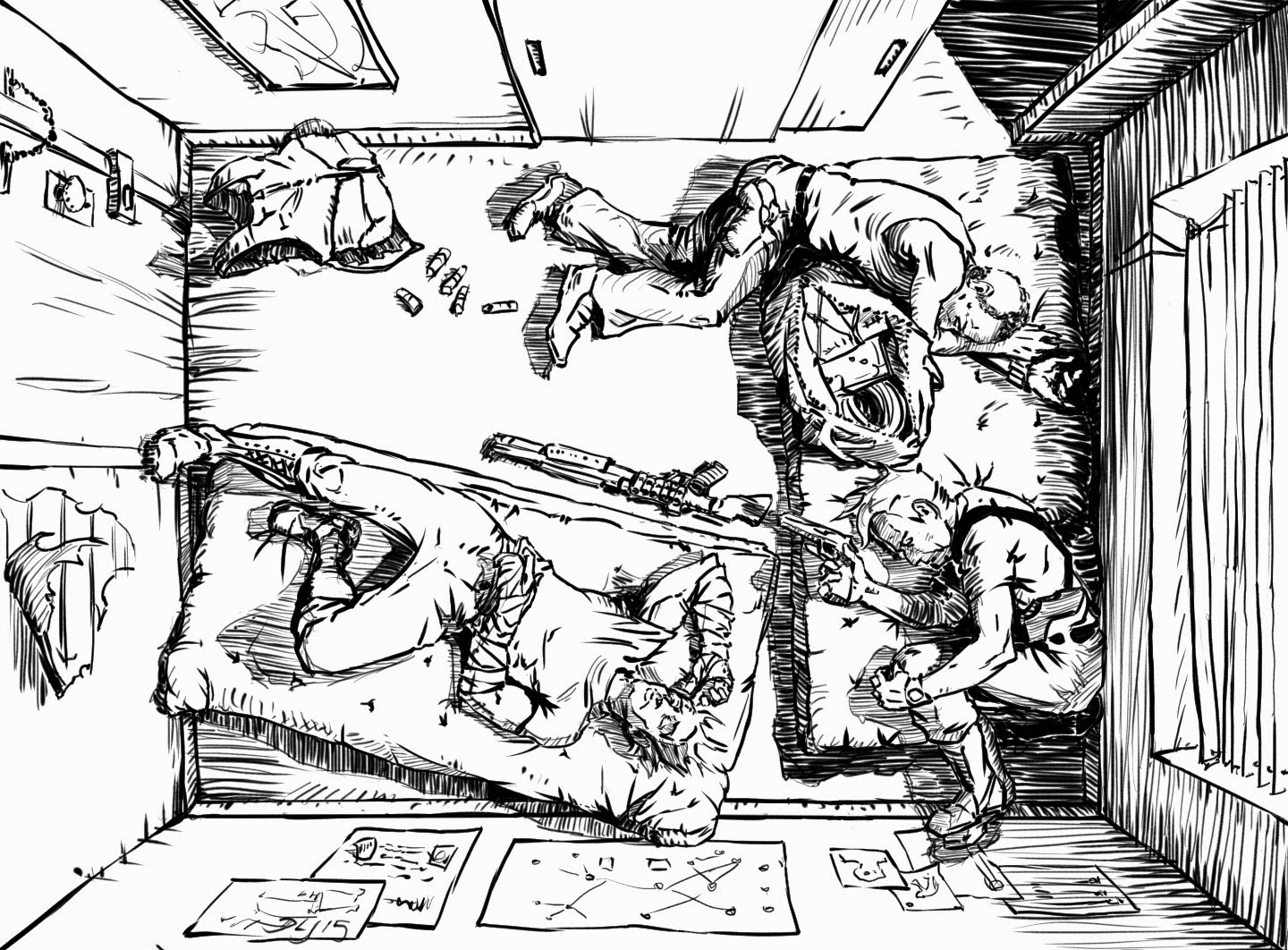
By David Lewis Johns
But it's not just setting generation. The GM tools in this book give you resources for creating a pantheon, alien races, occult artefacts, spells, monsters, locations, cults, crime scenes, scenarios ... the list goes on. And although you generate these randomly, there isn't the goofy effect you get from most random tables (at least not in most cases). Each result could possibly kick off a compelling scenario. It must have the highest good-content-to-page-count ratio of any Lovecraftian anything since ... since I don't know when. There's even a system for running the conflicts between cults behind the scenes -- I like the idea, which is almost like its own little minigame, although personally I tend to just run these things by GM fiat. Still, it's got a lot of interesting ideas.

I don't think I'm doing a very good job explaining what I love about this and why, so I'm going to give you a more practical demonstration using two methods. First, if you haven't done so already you should go and download the free Stars Without Number rules. Once you've done that, check out the system tags. If you think those are a good idea, imagine the same thing adapted to a Lovecraftian horror setting by someone who gets it and then expanded to every other aspect of what you might want from a horror game. If that sounds good, you should buy this game.

Second, as I said, I'm going to put this into practice myself -- although at the rate I'm currently writing, it might not be until next week when I have wrapped up current work and returned from Salute 2015. But I think I can do a better job of showing why I like this game than telling, so stay tuned.

An Elegant Statement of OSR Philosophy

One thing I wasn't expecting to find in the rulebook was a really plain statement of one of my favourite things about the OSR's approach to systems. It's something I've encountered when running my D&D game, and it's something that I, as a dude who spent a long time immersed in a certain way of thinking about game design, find really interesting. Let me find it:

One of the most useful traits of old-school inspired games is that the great majority of them are crudely compatible with each other. They may not use the exact same scaling, and they may differ in details or particular mechanics, but you can usually look at one and see roughly how it might fit into another. 
As the GM of a sandbox campaign, you should take shameless advantage of this. ... The most important tool you have for salvaging this material is a certain insouciant attitude toward mechanical specifics. Do the pieces not fit together exactly? Are the save categories different? ... Don't worry about it. 
After years of teeth-gritting rules-fights in a national gaming society (and that's necessary, I get it -- a group with hundreds of members is a different animal) and the painstaking approach of indie games designers back in the early 2000s when I was paying a lot of attention to that stuff, I found the ability to sit down at the table and say "fuck it" unbelievably liberating. It sounds silly -- GM fudges game and improvises a lot; no kidding -- but somehow it was a big step for me and it's nice to see it written down.

Wrap-up

I like Silent Legions. I liked the previous Sine Nomine games and I like Lovecraftian horror, so I was pretty much in the bag for this right from the beginning. But you are not me, so let's see whether this is right for you.

You want to run a Lovecraftian horror sandbox: Yes, yes, a thousand times yes.

You want to incorporate Lovecraftian horror elements into an existing OSR game: I would say so. You might not be able to use some of the setting-creation stuff if you're coming into an existing campaign, but I think the rest of it will still be very useful for you.

You want to incorporate some material into an existing Call of Cthulhu or Trail of Cthulhu campaign: Again, yes, I think so. A lot of the artefact and creature and cult stuff will come in handy -- and the scenario generation as well. In many ways, I think this approach to monster creation is a lot more useful than the Cthulhu Pokedex, but I may just be a cranky old bastard who wants these kids to get off his lawn because they remind of when he too was young and a little too keen on this stuff.

So yeah, I think it's pretty good and you should get it. But if you don't believe me, stay tuned for an upcoming post in which I put some of this stuff into practice.