Showing posts with label horror. Show all posts

Wednesday, 22 April 2015

Silent Legions, Part One:

Late last year, I backed the Kickstarter for Silent Legions, the new horror roleplaying game from Sine Nomine's Kevin Crawford. I'm on record as being a big fan of previous Sine Nomine games like Stars Without Number and Other Dust, so I was in for this without a lot of reflection. Last week I picked up my hardback copy (I've had the PDF for ages, but haven't really got around to digging into it), so here is my review.

By Miguel Santos.
(Incidentally, as one of the stretch goals of the Kickstarter, Crawford put the game's art out for free use, so I'm going to illustrate with a lot of images from that.)

In my next post, I'm going to put some of the tools in the game to use and generate a sample setting, but I've got a busy week ahead so heaven knows when that will actually happen. Anyway, let's get down to our look at the game itself.

System Overview

Silent Legions is a relatively rules-light game, although it's still a "fat" game. I suppose what I mean is that it's rules-light, resource-heavy. The core of the system is a familiar model based on older versions of D&D. You have the traditional six stats, classes and levels, descending armour class, all that kind of thing. The saving throws are different, and there's a skill system, but if you've played any form of D&D -- and I expect that's most people -- it should be pretty easy to pick up.

The four classes are the Investigator, the Scholar, the Socialite and the Tough. These pretty much do what they say on the tin -- they get skills in relevant areas, they have different attack progressions, hit dice and saving throws, etc. The really distinctive feature of the classes is Expertise. Each character has a pool of Expertise points which represent the particular training or specialty of their class. Players can spend these expertise points to do things like reroll class skills or to activate class special abilities. For instance, at first level the Scholar can spend a point of Expertise to automatically succeed on a Knowledge skill roll, while the Tough can spend an Expertise point to automatically self-stabilise when knocked to 0 HP. That kind of thing.

In addition to classes, players also have Backgrounds, which give them some more skills and act as sort of specialisations. A Tough with the Soldier background and a Tough with the Police Officer background will be quite different, for instance -- and Police Officer might also be a good one for an Investigator.

Skills in Silent Legions, as in its sister games, are pretty forgiving. You start with a skill at 0, which allows you to roll 2d6 and add the relevant attribute with no penalty. The typical difficulty is somewhere around 8, so a character with just a +1 between attribute and skill will still succeed most of the time -- and even then, the rules suggest that many uses of skills should just be auto-successes if the character has the relevant skill at all.

Combat, by contrast, is super fucking deadly. In addition to its regular damage, each type of weapon has what's called a Slaughtering die. So, for instance, a shotgun does 3d4 damage and has a Slaughtering die of d10. When you roll the weapon's attack, you also roll the Slaughtering die. If it comes up 6 or better, the weapon does triple damage. So 50% of the time, a successful shotgun blast will kill a typical human stone goddamn dead with damage to spare. Which, you know, fair enough. Don't get shot with a shotgun if you want to stay alive. But it's not like there's a huge number of armour options available out there in the modern world. Primitive armour doesn't work against guns, ballistic armour doesn't work against not-guns, and everything is stupidly conspicuous.

By Luigi Castellani
So combat uses a d20 and has wildly dangerous damage results, while skill use runs on 2d6 and is pretty generous. The result is that using skills is relatively predictable, whereas every single time you go into a fight you're taking your life in your hands. That's true in the other Sine Nomine games, but it's even more true here and it's clearly intentional. I like it. It means that -- fighting monsters aside -- combat is going to be either fisticuffs or murder; the last thing you want is a fair fight with someone who's trying to kill you.

Heck, even if you succeed at murdering people, there's Madness to worry about. Madness in Silent Legions is a type of cumulative damage; it builds up, rather than wearing you down like it does in Call of Cthulhu, and you can buy down your total by buying Deliria, which are sort of behavioural coping mechanisms. You can accumulate Madness from different types of source: there's Bloodshed, Horror and the Occult. It's not a bad system, and it would be easy to bolt onto other games where you wanted a relatively light sanity system. It also -- and I think this is a good thing -- makes it very clear that the Madness you get from the things your characters are exposed to in the game and actual mental illness are totally different; you can have a character who is mentally ill but has a Madness of 0.

Magic

In Silent Legions, there are two types of magic: Spells, which are time-consuming rituals you do beforehand, which then produce a suspended effect, and Disciplines, which are more sort of psychic-powery and have an immediate effect. The distinction reminds me of the difference between Thaumaturgy and Evocation in the Dresden Files game (and, for all I know, books), although the parallel isn't exact. There are rules for learning both types of magic, and anyone can do them (although you need some Occult to do Spells effectively). You buy Disciplines like Skills, and then advance through ranks in them, much like Psychics do in Stars Without Number. In either case, you can either spend Expertise to cast the Spell or use the Discipline or rack up some Madness by doing so -- since Expertise is a pretty limited currency at lower levels, this seems like it would happen quickly.

Now, the Spells for which there are rules in Silent Legions are merely the spells of the "Gray Path," i.e. the kind-of-evil path that any old person can study. Most spells are not so gray -- they're flat-out evil and if you were to learn them, you'd no longer be a PC. These spells don't have a list; instead, they have a big old random-generation process. And it's in this section of the book that we really start to get into what I love about Sine Nomine games: the GM tools.

A ... World of Darkness? 

I feel like I never do a very good job of expressing what I love about the way Crawford presents game master tools. I always just say something like "it's all done with random tables" and then I think people put this down to a quirk of mine -- and in a way, it is. I definitely love random tables for reasons I can't fully explain.

But the setting generation tools in Stars Without Number, Other Dust and now Silent Legions aren't just "random tables." They're thematic hook-generating tools. They're like ... Traveller world creation if it only focused on the things that make for good adventures.

Key to the system is creating locations with tags. When you start assigning locations on your map, you generate tags for them. A tag is a short descriptor, like "Alien Bloodline" or "Senseless Violence." There are both occult tags and mundane tags, so you can create locations that don't necessarily have anything Mythos-y about them or you can mix the two to set a horror against a realistic background. Each tag comes with suggested hostile NPCs, allies, objectives, dark secrets and so on. A tag is a little scenario-generating engine, and each location has two of them.
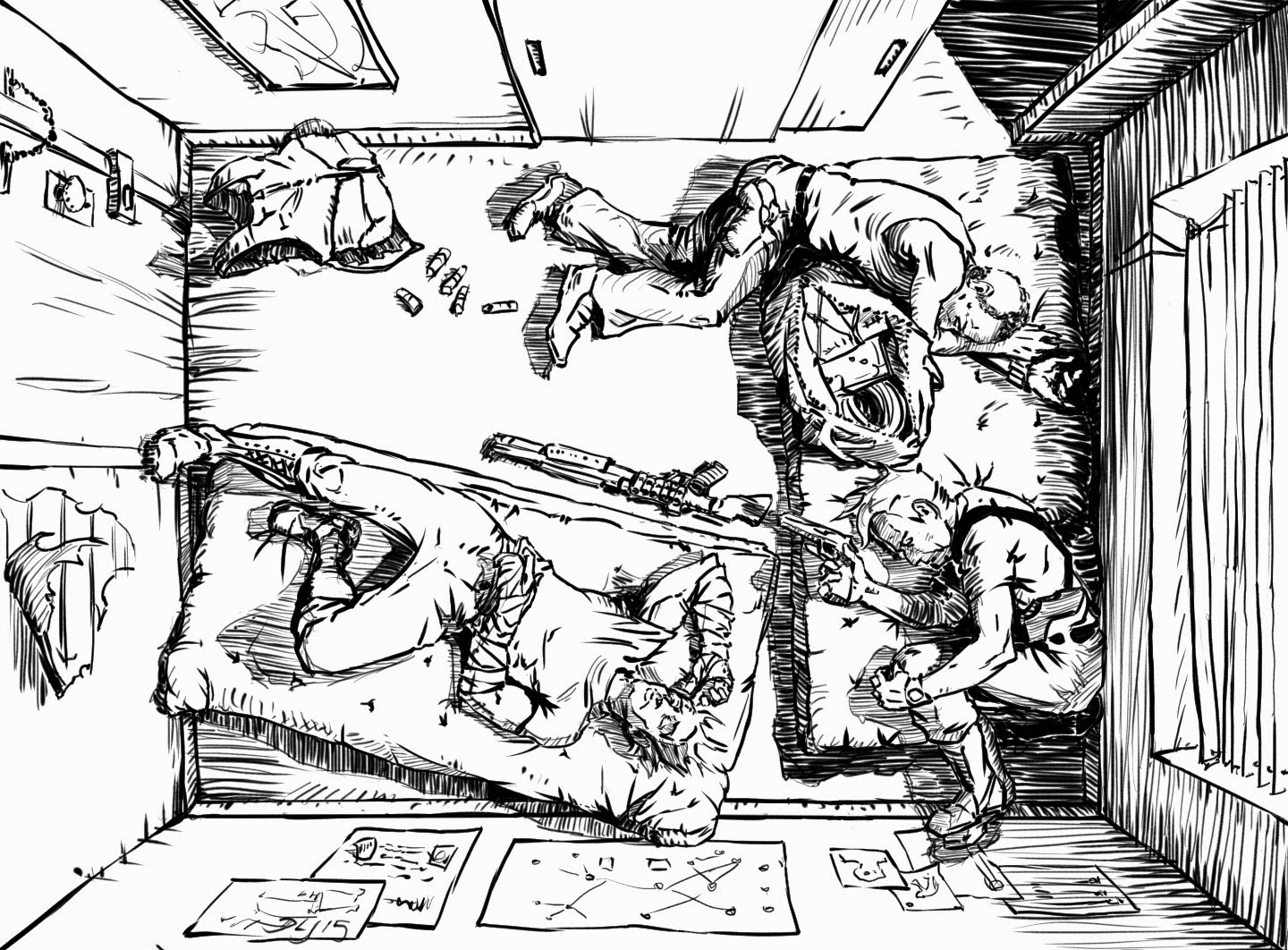
By David Lewis Johns
But it's not just setting generation. The GM tools in this book give you resources for creating a pantheon, alien races, occult artefacts, spells, monsters, locations, cults, crime scenes, scenarios ... the list goes on. And although you generate these randomly, there isn't the goofy effect you get from most random tables (at least not in most cases). Each result could possibly kick off a compelling scenario. It must have the highest good-content-to-page-count ratio of any Lovecraftian anything since ... since I don't know when. There's even a system for running the conflicts between cults behind the scenes -- I like the idea, which is almost like its own little minigame, although personally I tend to just run these things by GM fiat. Still, it's got a lot of interesting ideas.

I don't think I'm doing a very good job explaining what I love about this and why, so I'm going to give you a more practical demonstration using two methods. First, if you haven't done so already you should go and download the free Stars Without Number rules. Once you've done that, check out the system tags. If you think those are a good idea, imagine the same thing adapted to a Lovecraftian horror setting by someone who gets it and then expanded to every other aspect of what you might want from a horror game. If that sounds good, you should buy this game.

Second, as I said, I'm going to put this into practice myself -- although at the rate I'm currently writing, it might not be until next week when I have wrapped up current work and returned from Salute 2015. But I think I can do a better job of showing why I like this game than telling, so stay tuned.

An Elegant Statement of OSR Philosophy

One thing I wasn't expecting to find in the rulebook was a really plain statement of one of my favourite things about the OSR's approach to systems. It's something I've encountered when running my D&D game, and it's something that I, as a dude who spent a long time immersed in a certain way of thinking about game design, find really interesting. Let me find it:

One of the most useful traits of old-school inspired games is that the great majority of them are crudely compatible with each other. They may not use the exact same scaling, and they may differ in details or particular mechanics, but you can usually look at one and see roughly how it might fit into another. 
As the GM of a sandbox campaign, you should take shameless advantage of this. ... The most important tool you have for salvaging this material is a certain insouciant attitude toward mechanical specifics. Do the pieces not fit together exactly? Are the save categories different? ... Don't worry about it. 
After years of teeth-gritting rules-fights in a national gaming society (and that's necessary, I get it -- a group with hundreds of members is a different animal) and the painstaking approach of indie games designers back in the early 2000s when I was paying a lot of attention to that stuff, I found the ability to sit down at the table and say "fuck it" unbelievably liberating. It sounds silly -- GM fudges game and improvises a lot; no kidding -- but somehow it was a big step for me and it's nice to see it written down.

Wrap-up

I like Silent Legions. I liked the previous Sine Nomine games and I like Lovecraftian horror, so I was pretty much in the bag for this right from the beginning. But you are not me, so let's see whether this is right for you.

You want to run a Lovecraftian horror sandbox: Yes, yes, a thousand times yes.

You want to incorporate Lovecraftian horror elements into an existing OSR game: I would say so. You might not be able to use some of the setting-creation stuff if you're coming into an existing campaign, but I think the rest of it will still be very useful for you.

You want to incorporate some material into an existing Call of Cthulhu or Trail of Cthulhu campaign: Again, yes, I think so. A lot of the artefact and creature and cult stuff will come in handy -- and the scenario generation as well. In many ways, I think this approach to monster creation is a lot more useful than the Cthulhu Pokedex, but I may just be a cranky old bastard who wants these kids to get off his lawn because they remind of when he too was young and a little too keen on this stuff.

So yeah, I think it's pretty good and you should get it. But if you don't believe me, stay tuned for an upcoming post in which I put some of this stuff into practice.

Wednesday, 15 April 2015

What makes a monster "Lovecraftian"? Part 2: Practical tips

In my last post, I talked about what makes a monster "Lovecraftian" and came to the conclusion that there are a few different definitions. In this post I'm going to talk about how to give monsters in games that Lovecraft touch. In most cases, I find, it's not really the monster that matters at all -- it's the context in which the monster appears. Let's take a look.

Art by Luigi Castellani, from Silent Legions.
Time. Lovecraft's monsters are old. Heck, it's right in the name, in some cases: Great Old Ones! But what exactly that means can vary. Some Lovecraft creatures have been around for thousands or millions of years -- in some cases they actually died out long before the period of the story. In other cases, though, the history is a little shorter-term. The history of the Deep Ones in "The Shadow Over Innsmouth" goes back a few generations. But discovering the history is usually important. Heck, that's practically all that happens in "The Call of Cthulhu."

Place. I'm sure there are one or two examples, but I can't think of a Lovecraft story off the top of my head in which people are just minding their own business and a monster comes along and goes at them. In almost any case, the monster is tied to a place; that doesn't necessarily mean a habitat, but it's definitely a trend. Sometimes it's shocking because the monster doesn't belong, but a lot of the time the monster does belong -- and it's you who doesn't belong -- or the monster takes a place and begins warping it so that it belongs, like Joseph Curwen or the Deep Ones.

Revelation. A big briefing in the setting that says "yes, these are bad things from outside space and time and they threaten reality and blah blah blah" is not a good way to be introduced to a Lovecraftian horror. This actually works differently from a lot of monsters, where you want there to be some buildup. "Going to the woods? Watch out for the owlbear!" works, but I'm not convinced it works for something where the knowledge of it is supposed to be threatening. I'm looking at you here, Mage.

I guess what I'm saying is that a genuinely Lovecraftian creature is less about the beast's characteristics than about its context. The monster has a place and a history, which basically means that it has a setting and a story.

Which may explain why Lovecraftian critters shorn of their context -- like in the CoC monster books, to be perfectly frank -- don't really mean much. And it does remind us that, as I mentioned in  But with all the Pokemon-collecting, it can be easy to lose sight of that.

(Once again, I come back to how good the GM advice in the Call of Cthulhu d20 rules is.)

Pointlessness of actual game: 100%.
Now, just today I got my physical copy of Silent Legions, the fantastic new sandbox horror RPG from Sine Nomine. I haven't yet finished reading through it (although I read the PDF back when I backed the Kickstarter), and I will post a proper review once I'm done with it, but I did note a really interesting point about monsters in there:

Norms. One good idea is to have the monster violate some kind of rule or norm -- like a physical law, perhaps as addressed by the rules. This could be as simple as having them violate the law of gravity by floating, or it could be something weird like violating causality or experiencing time in reverse. It doesn't have to be big, but it needs to be something that indicates that this is not just a piece of hostile wildlife like an owlbear or a human stand-in like an orc or a supervillain like a lich. Obviously this is easiest in a realistic setting, because just doing monstery stuff is a violation, but whatever the rules of your setting are, bend them.

Language. If you're going to have an indescribable monster, a primarily verbal medium like an RPG seems like an ideal place to have that. Could you run a scene with a creature you literally can't describe? I kind of want to try it now. But I do think that, nine times out of ten, a very detailed, Barlowe-y approach to a monster is not gonna get you anywhere in a tabletop game; things have to be described in a shorthand kind of way -- and sketchy description that focuses more on verbs is actually going to be well-suited to that. I'm not going to pause to describe the creature any more than I would with a gnoll or a bugbear, but I was always going to use words to describe its actions, so it costs me nothing to say that it "lurches" or "shambles" or "suddenly appears" rather than that it "moves."

I guess part of what I mean about laws and language is that you have to consider whatever your setting establishes as a norm and then mess with it. If your setting already has Ilithids and aboleths and gricks and giant squids, then you're not going to be able to just throw down some tentacles and call it a day. (Well, I might do this, but then the mythos-y elements in my D&D setting are more pulp adventure than horror; I'm trading on the known tropes rather than trying to create actual Lovecraftian dread.) (You could have just said "like in Hellboy, right," James.)

Actually, maybe all I mean is go look at Hellboy for a setting that has cyborg apes and ghosts and werewolves and vampires and still manages to make its cosmic horror monsters qualitatively different.


And of course, that's leaving out the old Kirby-anecdote approach (you know, the one where Kirby goes to the comic company and some youngster says he's going to do things "the Kirby way" and Kirby says "doesn't that guy realise the Kirby way is doing it your own way?" Words to that effect, anyway). After all, the whole point of Lovecraft's "anti-mythology" was to escape boring old ghosts and goblins. If Cthulhu is too tamed, skip it and do something else.

So anyway, that's just me thinking about the topic late at night by myself. I will now take a moment for obligatory plug time!

Speaking of Lovecraft and monsters, I wrote a thing -- a little ebook that is a Lovecraftian (I hope) horror story set in the Viking age. It's called The Barest Branch, and you can buy it on US Amazon, buy it on UK Amazon or pick it up in both Kindle format and .pdf on DriveThru. You might like it, and it's not very expensive.

Monday, 6 April 2015

Fishmen! (First in an occasional series)

So, as my D&D game takes to the waves and I get excited about playing some Strange Aeons again, my thoughts naturally turn to fishmen. Let's take a look at some of the many, many aquatic bad guy minis I own. Today's contestants are from the Reaper Miniatures Bones line and I think they look rather nice.


These are your rank-and-file types. The models are identical, but I painted them probably a year apart. I didn't prime them (supposedly you don't have to with Bones), but laid down a base of GW Hawk Turquoise, then highlighted up with that plus VMC Sky Blue and some patches of VMC Emerald. I picked out the eyes and light with VMC Fluorescent Green and Yellow Green, then gave the whole model a pair of washes. The back and the upper part of the head got a green wash, while the body got a blue wash. The result was to make the upper part of the body a bit darker, which was nice. For very quick models, I think they look rather nice, although I think the bottom one, which is the first one I painted, came out better. The fin on the back looks better and the striations on the scales are more visible. The wash on the second guy also dried a little glossy, which is not a deal-breaker for fishmen. 


This is the champion from the same line, with more of a coelacanth look to him than the anglerfish the others resemble. I reversed the colours on this guy, with a blue wash on the crest and armour plates and a green wash on the exposed skin. Again, a quickie paint job but I think he looks not bad.


The four arms on this leader are a dead giveaway that he's meant to be a D&D Sahuagin Baron, but again I think he'll do nicely as a monster in lots of other games. I was getting a bit impatient with painting seashells by this point -- impatience is my besetting sin as a painter -- but I still think that overall he looks good. I'm pleased with the limited palette of the group in general.

Now, as I said, these guys might turn up in my D&D game, but I'm also putting together a little Vikings-and-sea-monsters game to celebrate my putting my mythos-in-the-dark-ages novella, The Barest Branch, up for sale on Amazon. (It's also still on DriveThru if you want to buy it there.) So hopefully I'll have a little more of a review of the characters I'll be using for that game soon.

Wednesday, 24 December 2014

Maelstrom Domesday -- full readthrough

In a previous post I talked about creating a character for Maelstrom Domesday, an updated version of the classic 1980s British game with the setting moved to Yorkshire in 1086. You can find the game itself and its various supplements on DTRPG. (And Arion Games has a big sale on through new year, so you can pick them up cheap. I think I may get the scenario just to give the game a try.)


Having finished character creation, I thought I'd take a look at how the abilities I acquired actually work. 

So, skills: Skills are ranked from 1 to 6, with each level having its own effect. You roll against the relevant attribute (which you will remember go from 1 to 100, so this is basically a percentile system), and having the skill usually adds 10% per level to your score. However, it's worth checking, because some skills have different effects. For instance, higher levels of Herbalism allow you to use rarer herbs, speed up your prep time, and so on, while Combat Training adds to your damage, increases the protective value of armour, and that kind of thing. 

Combat is done by percentile, like skill checks -- you roll and compare your result to the other player's (each player has attack and defense scores) on a matrix sort of like the one used in HeroQuest. This tells you how much damage you've taken. Each hit heals and is treated separately. There are also serious and critical wounds, which have extra consequences, including being hideously scarred, losing an eye and whatnot. I haven't tested it in play, but combat looks lethal, with a big advantage for the guy with the higher skill and the better weapons and armour. 

There's the usual other stuff -- diseases, poisons, fire, falling, earning your patron's favour, most of it simple spot rules. Instability is the game's answer to Sanity, and is basically another form of damage you can take. 

Magic (or Magick) is at the centre of the setting, but player character magick is pretty subtle. You can't use it to do anything that would otherwise be impossible, so it's mostly things like avoiding detection, changing minds, putting people to sleep, spotting things, all that kind of thing. Even so, if you have a non-magickal method of doing stuff, you're better off using it, because magick use carries with it the possibility of a Maelstrom breach -- that is, a moment where the weird chaotic magickal dimension that underlies ours pokes through. This can mean anything from turning people ill-tempered for a little while to summoning hideous entities from other planes (though the odds of this are pretty slim on a simple spell). 

So rules (particularly character creation) take up about half of the book, and the other half is all setting and GM resources. The bestiary covers wildlife and a handful of different monsters, ranging from "minor" creatures like elves and boggarts and the undead to "major" ones like giants and dragons. I think it's understood that there aren't going to be a lot of common monster types in this game -- most problems are going to be caused by a creature that is, in proper weird fantasy style, unique. 

The original setting guide is not easy reading. 
Then there is a lot of material on daily life 1086 and Yorkshire in particular. Now, I feel pretty good about my grip on the world of the late 11th century, but this seems clear and well-organised, detailed without beating the reader to death with minutiae (although my tolerance for historical minutiae is probably in the top 5%). 

I really like the way Yorkshire villages are laid out -- a few facts from the Domesday Book, and then a piece of local folklore and an adventure hook for each. The setting section covers 37 manors in this faction, plus one small town (Selby) and one large city (York). The town and city get much more detail, with relevant NPCs and multiple plot hooks. 

Then you get the appendices, which cover diseases, medicinal herbs (a lot of medicinal herbs), a quick timeline and a glossary. 

Production-wise, the book is OK. The layout is clean and usually readable, the art is sparse but generally pretty good. I haven't looked at any of the electronic products, but if they're laid out like this I would assume they're easy to read onscreen and economical to print. There are some fuzzy bits of poorly-reproduced art, and at least one repeated piece, but nothing too jarring. 

When I bought this game, I initially thought that it would be something like Spaceship Zero -- essentially a high-concept campaign-in-a-box that I might run for a limited series of games and be perfectly content with. Reading it through, I find it has a lot of worky bits that can be pulled out for other games. It could mash up very simply with Cthulhu Dark Ages, for instance, or with Mythic Iceland. The village writeup format is good, and I'll probably swipe that for other games. Maybe also the medicinal herbs, although they're not weird enough for a fantasy game. Maybe for another Taming of Dragon Pass type game. And it's a pretty good resource for any type of game set in 11th-c. England, fantasy or otherwise, although I already have a fair few reference works on the subject. 

So yeah. I am going to try to run this at some point! I have a pretty clear idea of the campaign already. 

Friday, 19 December 2014

Maelstrom: Domesday character creation

So, I promised I would work my way through the character creation process for Maelstrom Domesday, the game I picked up at Dragonmeet.


This is a game of supernatural investigation in the early middle ages. That makes it the game for me, as you can maybe tell from this image of a small part of my bookshelves:


So, the way character creation in this game works is via a lifepath system. You can either determine your character's background randomly or pick the individual steps, but the system encourages you to do it randomly. I approve, because I'm a big fan of random character generation. I know some people don't like it, but I find it inspiring.

I went through the process twice, just for laughs, but this is my first one.

First off, you generate your starting attributes. There are ten of these -- nothing too exotic. They all start at 40, with most humans having scores in the 30-80 range. You choose four to add d6 to, then select another two to subtract d6 from. I chose to buff up my Attack, Persuasion, Perception and Knowledge and then reduce my Missile and Speed skills. It seemed fair enough for a supernatural investigator type, but the whole point of character creation is that until you get pulled into the world of the supernatural you're just an ordinary person.

Next you roll for your character's "racial" origin -- for the first guy, I rolled Saxon, which is the most likely result, as you might expect from a game set in 11th-century Yorkshire. I then rolled for his social background, and it came up with statistically the likeliest result: a peasant.

Next you roll for three "characteristics," which are various special traits and abilities. I rolled one that made me better at archery, one that improved my mathematics, making me better at bartering and so on, and one that gave me the ability to do hedge magic -- this lets me learn the Magic skill, but only to level 1.

Once you've found your social class, you roll for your starting career -- each background has a different distribution of possible careers. So for instance, if you're a noble, you're going to wind up being a squire or something, while if you're a peasant, not so much. I rolled for my first career and wound up as a wiseman, a sort of kooky village advice-giver / herbalist guy. And I could even learn magic, so that worked out nicely.

Each time you progress through a career, you add a certain amount to your age (it varies depending on the career), then add some points to a set of attributes specified by the career plus a discretionary one. In the case of a Wiseman, these are will, endurance and perception. You also get to spend two points from the various skills available to you. Wisemen have a lot of skills, so I chose different ones each time. You also roll on a random table, with the table being determined by what kind of occupation you have -- sedentary, in the case of a wiseman. Lastly, you can also get some equipment (a random chance) and an amount of money (there's also starting money based on your social class). You then roll to see whether it's your last career, and what career you move on to. I was a Wiseman several times in a row -- it's a pretty restrictive career. As a result, my skills are varied and my Wiseman-relevant stats are great.

The random events were my favourite thing about character creation; at one point, I learned philosophy, which apparently helps me resist something called Imbalance (I haven't read the actual rules). At another, I accidentally set myself on fire, giving me some hideous facial scars.

At the end of my career (you keep rolling to see if your career ends; if you roll over your age it does) I then rolled to see what my encounter with the supernatural had been -- apparently a tapestry shifted walls overnight!

Unfortunately, my contact with the supernatural drove me out of society -- I guess they didn't notice that I could do magic in the first place -- but one magnate decided to retain my services as a supernatural investigator. I rolled to see who it was -- Richard fitz Gilbert, of all people. Great.

So I'm a horribly-scarred, half-educated hedge wizard that no one will have anything to do with because of my role in the weird tapestry incident. Fortunately, I've picked up a smattering of philosophy, so I don't let it bother me too much. My character is a prize weirdo, and I get the feeling this is pretty common among characters in this game.

I made a little picture of him:

His name is Ealdred.
I'm going to enjoy running this game.